
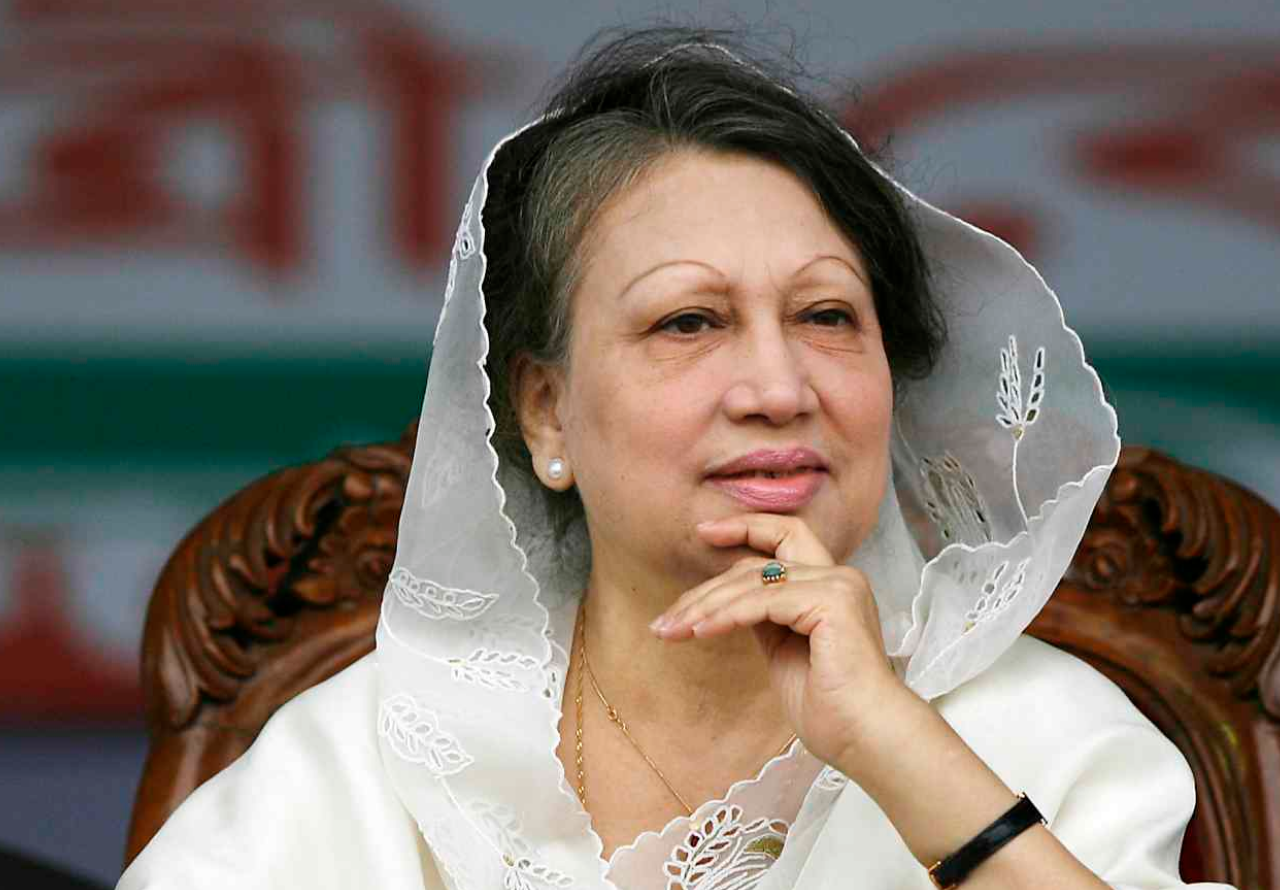
Khaleda Zia was an important Bangladeshi politician. She was also known as Begum Khaleda Zia. Khaleda Zia was the Prime Minister of Bangladesh for three times. These times were from 1991 to 1996 for a short time in 1996 and finally from 2001 to 2006. Khaleda Zia was the woman to be the Prime Minister of Bangladesh. She was also the woman to lead a Muslim country after Benazir Bhutto who was from Pakistan. Khaleda Zia was a politician, in Bangladesh. The Bangladesh Nationalist Party (BNP) had a chairperson from 1984 until she died. This person was very important in Bangladesh politics. The Bangladesh Nationalist Party was led by her through times and bad times. She helped the Party (BNP) during times when Bangladesh was growing fast. She also helped the Party (BNP) during times when there were a lot of problems, in Bangladesh politics. The Bangladesh Nationalist Party (BNP) and Bangladesh were very lucky to have her as the chairperson of the Bangladesh Nationalist Party (BNP).
Khaleda Zias life was closely connected to her husband Ziaur Rahman. He was an army officer who became the president of Bangladesh. Khaleda Zia and Ziaur Rahmans story is a lot of things. It is about the loss they experienced. It is also about the strength and determination that defined Khaleda Zias life and her career, in politics. Khaleda Zias journey was really shaped by what happened to her and Ziaur Rahman.
Early Life and Education
Khaleda Zia was born as Khaleda Khanam Putul on 15 August 1945. She was born in Jalpaiguri, which’s in the Bengal Province, British India. Now this place is known as West Bengal, India. Khaleda Zia was the child in her family. She had four siblings. Khaleda Zias family was a Muslim family. Her father was Iskandar Ali Majumder. He was a businessman who worked with tea. Khaleda Zias mother was Taiyaba Majumder. She was, from a village called Chandbari in West Dinajpur.
After the Partition of Bengal in 1947 Khaledas family moved to Dinajpur in East Bengal, which later became part of Pakistan. Khaleda said she was self-educated. She went to Dinajpur Missionary School. Then Dinajpur Girls School.. She did not finish her higher education.
Khaleda grew up in a family. This taught her to be strong and independent. She also learned to be disciplined. These traits really defined Khaledas personality as a politician. Khaledas family and her life in Dinajpur had an impact, on her.
In 1960 she married Ziaur Rahman. He was a captain in the Pakistan Army at that time. This marriage changed her life. Now she was, in the eye but only to support her husband who was an army officer. They had two kids, Ziaur Rahman and his wife had two sons. The first son is Tarique Rahman he was born in 1967. The second son is Arafat Rahman he was born in 1969. Tarique Rahman and Arafat Rahman both got into politics when they grew up. Tarique Rahman became a name in the BNP.
Bangladesh Liberation War
The Bangladesh Liberation War was a tough time for Khaleda Zia and her family in 1971. They were in a lot of danger. The Pakistani army had taken over Dhaka. They would often search areas where they thought people who wanted independence might be hiding. Khaleda Zia and her kids had to keep moving from one place to another so they would not get caught.
In July 1971 the Pakistani authorities finally caught Khaleda Zia. Put her in jail in different places like the old Parliament building and Dhaka Cantonment. Khaleda Zia had to go through a lot during this time. The Bangladesh Liberation War was a difficult time, for Khaleda Zia and her family. She stayed in detention until the sixteenth of December nineteen seventy one. This was the day that the Pakistani army gave up and Bangladesh finally became a country. Bangladesh got its independence on this day. It was a big moment for Bangladesh. The Pakistani army. Bangladesh was free at last which was a great thing, for Bangladesh.
Khaleda Zia had some bad things happen to her and this had a big effect on her life. These bad experiences made Khaleda Zia feel strongly about her country and she understood what it means to be in a tough spot in politics. Khaleda Zia was very brave, during this time. This bravery would later be something that people thought of when they thought of Khaleda Zia.
The Tragic Death of Ziaur Rahman
Khaleda Zias life changed a lot on 30 May 1981. This was the day her husband, President Ziaur Rahman was killed during a failed coup in Chittagong. President Ziaur Rahman was an army officer when Bangladesh was part of Pakistan. He did a lot to help Bangladesh become independent. Later he became the president of Bangladesh in 1977. He rose through the ranks, in the military. Started the Bangladesh Nationalist Party in 1978. Khaleda Zias husband, President Ziaur Rahman played a role in the countrys history.
Something bad happened at the Chittagong Circuit House. This is where Ziaur Rahman was staying. He was getting ready to make some changes to the politics. Some army officers did not like the way Ziaur Rahman was leading. They wanted to be in charge. So they attacked him. Ziaur Rahman was. He died. This was a shock to the whole country. The people who did this tried to take over the government.. They did not succeed. What they did do was create a lot of confusion and make people very scared. The assassination of Ziaur Rahman was a deal. Ziaur Rahmans death had an impact, on the nation.
Khaleda Zia was not a name, in politics back then. She became famous all of sudden because of a very sad event. Her husband was. That made her a widow when she was just 36 years old. She had two kids to take care of.. Khaleda Zia was strong and she wanted to keep her husbands political work alive. She also wanted to keep her family safe. Khaleda Zia got into politics because she had to and because she felt she had to do something for the BNP. The BNP was still a party and it was struggling after Ziaur Rahman died. Khaleda Zia wanted to help the BNP stay together.
Rise in Politics
After her husband was killed Khaleda Zia took charge of the BNP in 1984. Became the chairperson of the BNP. The BNP was a challenge for Khaleda Zia. She had to keep the BNP and make sure it did what her husband wanted. Bangladesh was also a difficult place to be in charge of the BNP because the military was in control. With all these problems Khaleda Zia became a leader of the whole country over time. She was the leader of the BNP and people, in Bangladesh started to know her as a leader of the BNP.
In the 1980s Khaleda Zia was against General Hussain Muhammad Ershad and his military rule. Khaleda Zia organized protests and rallies and strikes. She did this when it was very dangerous, for her. Khaleda Zia was put under house arrest times.. Khaleda Zia did not give up.
Khaleda Zia was very brave. She kept going. This is why people started to support Khaleda Zia. Khaleda Zia became known as a leader who was not afraid to stand up to people in power.
In 1991 something big happened in Bangladesh. General Ershad resigned from his job. After that Bangladesh started to have a democracy. Then they had elections. Khaleda Zias party, the BNP got the votes. Khaleda Zia became the female Prime Minister of Bangladesh. This was a big deal in South Asian politics. Khaleda Zia being the Prime Minister of Bangladesh was a moment for Bangladesh and, for South Asian politics.
Premiership and Governance
Khaleda Zia was the Prime Minister and her time in this position was notable for the reforms that Khaleda Zia made. Khaleda Zia also worked on developing the infrastructure and starting programs.
When Khaleda Zia was first in office from 1991 to 1996 Khaleda Zia did a things to help the economy. Khaleda Zia introduced a value-added tax, which is also known as VAT. Khaleda Zia also privatized companies that the state owned. Additionally Khaleda Zia created areas for exporting goods.
Khaleda Zia thought education was very important. So Khaleda Zia made sure that primary education was free, for everyone and that everyone had to go to school. Khaleda Zia also started programs to help girls get an education all over the country.
Khaleda Zia had a term in 1996 but it was very short because of all the problems in the government. Her third term from 2001 to 2006 was a lot better for Bangladesh. Bangladesh had an increase in the money it made and more people wanted to invest in the country. There were also programs to help people in need. Khaleda Zia worked hard to make things better in the areas to make healthcare better and to make friends with other countries, for Bangladesh.
The woman had a lot of accomplishments but her time in office was also filled with a lot of problems. There were a lot of allegations of corruption and fights, between political groups. The Awami League, which is a rival of Bangladeshs other party did not like her at all. This made things very tense and divided people a lot. The Awami League and Bangladeshs other party just could not agree on things making it hard for her to do her job.
Legal Challenges and Later Life
Khaleda Zia had a lot of problems with the law after she was done being the Prime Minister. She had to deal with things like being accused of corruption, which put her in jail in 2018.. Then Khaleda Zia was let out of jail in 2020 because people felt sorry for her. On in 2024 Khaleda Zia was found not guilty in several cases. When Khaleda Zia was older she was still very important to the BNP. Khaleda Zia kept playing a role in Bangladeshi politics mostly through her son Tarique Rahman and the other people, in her party the BNP.
Khaleda Zias life was really tough. Her younger son, Arafat Rahman died in 2015 because his heart stopped working. This was very hard for Khaleda Zia. She had a lot of health problems, like kidneys and liver diabetes and rheumatoid arthritis.. Khaleda Zia did not stop doing politics. She kept going. People still saw her as a strong female leader, Khaleda Zia.
Death and Legacy
Khaleda Zia was very sick for a time and had to go to the hospital many times. She even went to a hospital in London in 2025. Khaleda Zia died on 30 December 2025 at Evercare Hospital in Dhaka. When Khaleda Zia died people over the country were very sad. Leaders from around the world said nice things, about Khaleda Zia.
Khaleda Zia is an important woman, in South Asia because she was one of the first females to be a leader. She went through a lot of times like when her husband was killed but she kept going. Khaleda Zia is committed to helping Bangladesh become a country.
From the time her husband was assassinated to the time she became the leader of the BNP and the Prime Minister of Bangladesh Khaleda Zias life is an example of how strong and brave she is. Khaleda Zia always puts Bangladesh first. That is what makes her story so amazing.
Khaleda Zia’s journey—from a young widow to Bangladesh’s first female Prime Minister—serves as a testament to the power of determination and leadership under adversity. Her life and career remain an enduring inspiration, particularly for women in politics across South Asia.