
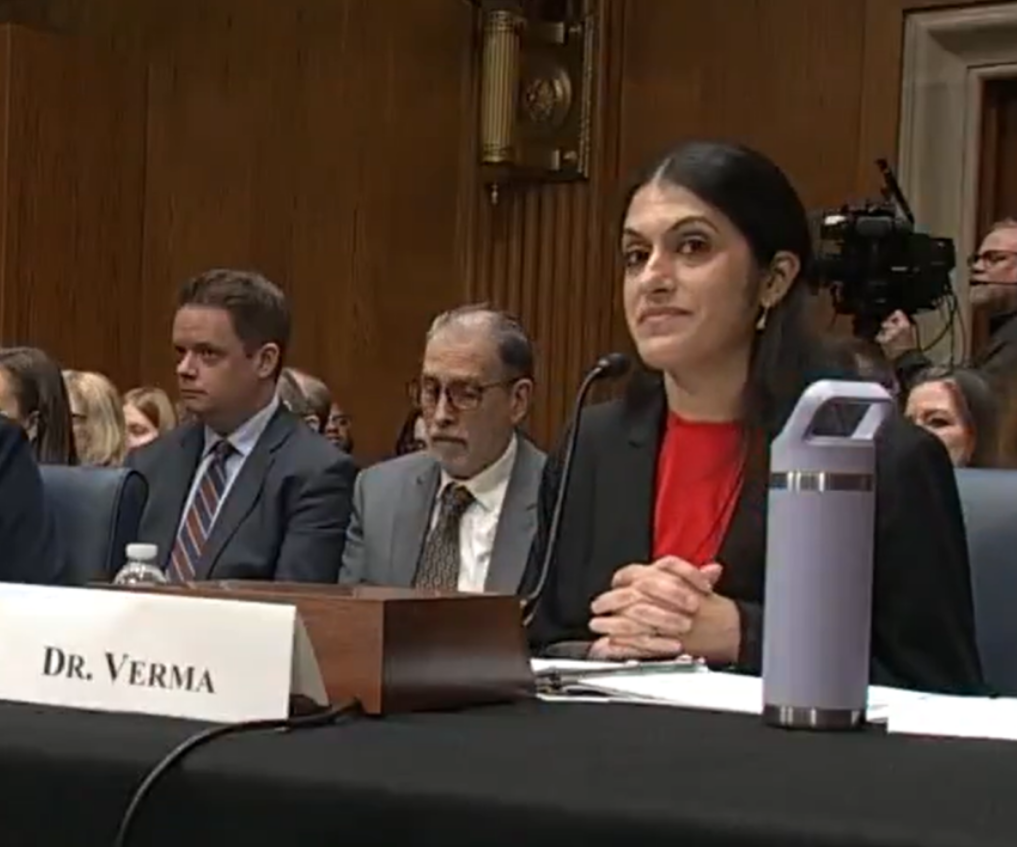
An Indian-origin obstetrician and gynaecologist called Dr. Nisha Verma, working in Atlanta, has gained a name both nationally and internationally due to a tense exchange during a US Senate Health, Education, Labor, and Pensions (HELP) Committee hearing on the subject of abortion. The board-certified OB-GYN became a viral sensation after she refused to provide a direct yes-or-no response to recurrent questions posed by Senators Ashley Moody and Josh Hawley on whether or not men can get pregnant. Her level-headed reaction, which featured her stressing the diversity of patients and characterizing this type of questioning as political and not medical, sparked national discussions about abortion policy, gender dynamics, and medical terminology…
Early Life and Indian Roots
Nisha Verma is a native-born Indian of Indian parents born in Greensboro, North Carolina. She was raised in a family that was influenced by the Indian cultural and American social systems, which is why she became aware of healthcare disparities, cultural identity, and serving the public at a young age. Her upbringing was one of the influences that led to her interest in medicine, social justice, and health policy.
She has repeatedly been featured in the media since her viral Senate appearance due to her Indian heritage as more and more Indian-origin professionals start to shape healthcare and public policy in the United States.
Scholastic and Medical Education.
The academic journey of Dr. Verma has a good interdisciplinary background of science, medicine, and the health of the population.
She has a Bachelor of degree in Biology and Anthropology, a course that enabled her to take a course in human biology, as well as a course in social and cultural systems, offered by the University of North Carolina. She persisted with the same institution and took her Doctor of Medicine (MD) degree.
After her medical school, she then underwent the residency training program in Obstetrics and Gynecology in Beth Israel Deaconess Medical Center, a major teaching hospital, which is affiliated to Harvard Medical School. It was there that she got a lot of clinical experience on women and pregnancy, as well as reproductive medicine.
Subsequently, Dr. Verma pursued a Complex Family Planning Fellowship at Emory University, which is a very specialized program on abortion care, contraception, and high-risk pregnancy management. Together with this fellowship, she also obtained a Master of Public Health (MPH) at Emory University, which expanded her knowledge base in the areas of healthcare systems, policy analysis, and population health.
She has since become a board-certified obstetrician-gynecologist, and a subspecialist in complicated family planning.
Professional Roles and Clinical Practice.
Dr. Nisha Verma has been in various powerful positions that are a combination of clinical medicine, academic teaching, and policy advocacy in the country.
She works as the Senior Advisor of Reproductive Health Policy and Advocacy at the American College of Obstetricians and Gynecologists (ACOG) one of the most powerful and reputable medical organizations in the United States. In the position, she assists in the formulation of national reproductive health policy, assists doctors working around limiting abortion regulations, and serves as a supporter of scientifically based medical recommendations.
Besides that, Dr. Verma is an Adjunct Assistant Professor at the Emory University School of Medicine where she is involved in the medical education and mentorship.
She is still an active clinician even in her policy responsibilities. Dr. Verma offers full-scale reproductive care in such states as Georgia and Maryland, and treating patients with a high variety of medical and social histories.
Research and Advocacy Work
A major aspect of the work of Dr. Verma is research and advocacy associated with abortion access and reproductive justice.
She has been called before Congress in the US several times to testify of the practical effects of abortion restrictions on patients and healthcare providers. She relies on clinical experience, as well as on the data of public health in her testimony.
Dr. Verma is now the owner of a research grant that will explore the effect of the six-week abortion ban in Georgia and especially on individuals who have high-risk pregnancies. Her publications record the impact of the restrictive legislations on medical decision-making, patient safety, and outcomes in vulnerable groups.
She has also been to the United States a lot, conducting training to physicians on evidence based abortion care and spearheading the educational programs on how the physicians could effectively communicate with the patients in the face of mounting legal and political pressure.
In response to the Dobbs case, a decision of the Supreme Court overturning Roe v. The active role played by Wade, Dr. Verma was in assisting physicians and healthcare institutions in the face of a fast evolving legal environment by ACOG.
The HELP Committee Hearing of Viral US Senate.
Nisha Verma Dr. Nisha Verma gained national attention when she was a Democratic witness at a hearing in the HELP Committee of the United States Senate entitled Protecting Women: Exposing the Dangers of Chemical Abortion Drugs.
There were multiple attempts by Republican Senators at the hearing to get Dr. Verma to answer if men are able to get pregnant, with the senators including Josh Hawley and Ashley Moody making such inquiries numerous times. The question was made in the form of the demand of a yes-or-no answer.
Instead of answering her question directly, Dr. Verma responded that she handles a large number of patients with multiple identities and referred to the questioning as polarizing. She wrote that although science and evidence ought to be at the core of medicine, such dichotomous questions are usually applied as political instruments instead of medical ones.
Senator Hawley was highly combative claiming that pregnancy is a biological fact that is exclusive to women and that Dr. Verma was unable to accept basic science. She stood her ground despite constant pressure, and she focused on patient-centered care and the complexity of clinical practice in the real world.
The trade soon spread virally on social media, with both backlash and acclaim. Proponents claimed that Dr. Verma acted as a professional and opposed politics whilst opponents left her claiming that Dr. Verma was escapist.
National Effect and Social Response.
The senate debate turned Dr. Nisha Verma into a representation of the wider American discussions on:
- Medication abortion safety and abortion policy.
- Gender-diverse and transgender healthcare.
- Science or politics in medical testimony.
- Inclusivity and language in healthcare institutions.
The moment has been mentioned by policymakers, healthcare experts, and the general population as evidence of how discussions about reproductive health are becoming more culturally and politically opposed instead of medically agreed upon.
The answer by Dr. Verma to many in the medical fraternity underscored the duty of the doctors in ensuring that their care to the patient remains unmarred by political rhetoric particularly in the political arena.
Identity as a Physician of Indian Origin.
Dr. Verma is an Indian-origin physician engaged in the upper echelons of the US healthcare policy, and he is a symbol of the rising prominence of South Asian professionals in the healthcare sphere and politics worldwide. Her exposure has elicited debates on the position of immigrants, their portrayal, and the obstacles minority professionals encounter when politicking in highly contentious societal arenas.
Her experience demonstrates that the contemporary healthcare leadership is intertwined with the concepts of medicine, identity, and advocacy.
Conclusion
Dr. Nisha Verma is much more than a viral speech at a Senate hearing. She is a physician, expert in the field of public health, educator, researcher, and advisor in national policy whose accomplishments have a direct impact on the accessibility of reproductive healthcare in the United States.
Her avoidance of simplifying complex medical situations into politically expedient solutions is a highlight of her dedication to evidence-based medicine that is patient-centered. With the ongoing discussions on abortion, gender identity, and healthcare regulation, Dr. Verma will likely have a voice in the policy and practice.
In a time when medicine and politics are getting dangerously close, Dr. Nisha Verma can be considered one of the iconic figures at this crossroads.