
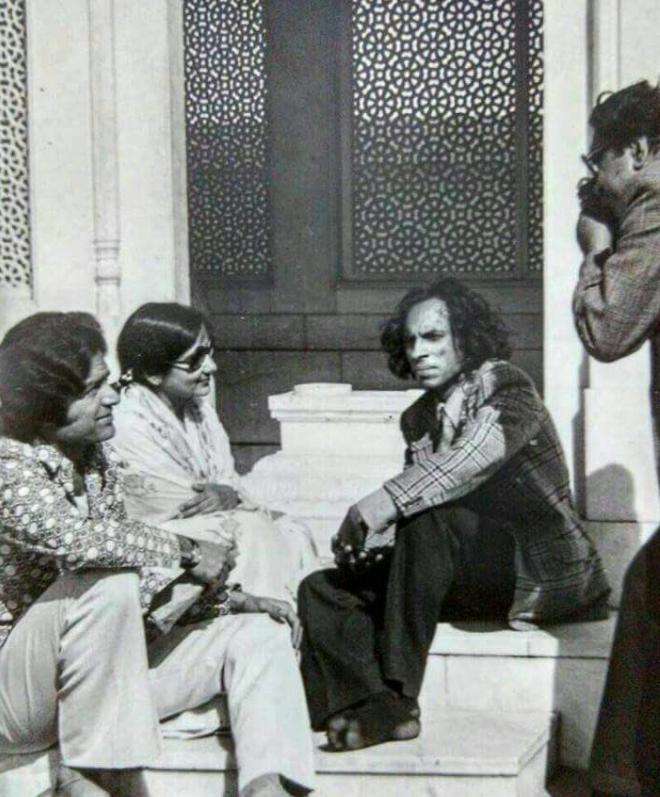
Syed Hussain Sibt-e-Asghar Naqvi (14 December 1931 -8 November 2002), known by his pen name Jaun Elia, is one of the most fascinating personalities in the contemporary Urdu literature. Famous with his ghazals and unorthodox manner, Elia was not only a poet of romantic hopelessness, but also the philosopher, the thinker of the intellectual and political life in which he was involved in his works was exploring the innermost depth of the human soul and society. His work and life is still relevant to the generations of poets, thinkers and writers in South Asia.
Early Life and Family
Jaun Elia was born on 14 December 1931 in Amroha, Uttar Pradesh, British India in a very intellectual Shia family. He was also the youngest son of Allama Shafiq Hassan Elia, a literary and astronomical scholar, knowledgeable in Arabic, English, Persian, Sanskrit and Hebrew. His father was well versed in a lot of knowledge and also corresponded with the most prominent thinkers, such as Bertrand Russell, which provided Jaun with an intellectually stimulating background since his early years.
The siblings of Jaun were outstanding as well. His older brother, Rais Amrohvi, was a renowned poet and psychoanalyst, with another brother, Syed Mohammed Taqi, being a philosopher and translator who made a significant translation of Karl Marx: Das Kapital to Urdu. His family had other links with distinguished people in arts and cinema: Kamal Amrohi is his first cousin who was an Indian film director and Munawar Saeed, a villainous actor, is another relative.
Jaun was famous as a child prodigy and had his early education at the Syed-ul-Madaris in Amroha which was a madrasa of the Darul Uloom Deoband where he studied the degrees of Adeeb Kamil (Urdu), Kamil (Persian), and Fazil (Arabic). He was raised with a passion of language, philosophy and the classics of both eastern and western literature.
Personal Life and Marriage
In the year 1970, Jaun Elia got married to the renowned Urdu author Zahida Hina whom he had met through the publication of the Urdu magazine Insha. Their marriage, however, did not go off well and they divorced in 1984 because of incompatibility of their temperament. The termination of this relationship had a profound effect on the theme of love, loss as well as alienation in his poems. Even though they were separated, Zahida Hina and Jaun Elia continued playing significant roles in the literary and intellectual life of one another.
Migration and Political attitudes.
They did not support the Partition of India, though Jaun Elia, an ideologically communist, moved to Pakistan in the year 1956 and settled in Karachi where he spent the rest of his life. His poetry was heavily infused with his political beliefs. He tended to applaud communism in his writings, pointing out the sense of class-consciousness and criticising the social injustices. As an anarchist, nihilist and poet, Elia wrote in a highly personal way upsetting traditional thought, whether literary or life in general.
He was disillusioned with the ideological principles of the establishment of Pakistan as an Islamic state, finding the establishment of this state as being inconsistent with the notion of Marxist ideologies. His poetry including Sarzameen-e-Khwab-o-Khayal (Land of Dreams and Imagination) tended to imagine revolutionary transformations with socialist and communist ideas. The political philosophy of Elia thus could not be detached of his literary work and presented a perfect blend of intellectualism and poetry.
Literary Career
Jaun Elia started writing poetry when he was only eight years but his first book, Shayad (Perhaps), was published when he was sixty. Nevertheless, even after such a belated discovery, he soon became famous in mushairas (poetic symposiums) in Pakistan and beyond, his recitations of an often dramatic and passionate nature winning the attention of audiences. His style did not follow conventional norms and that is why he was a distinctly influential voice in modern Urdu poetry.
Themes and Style
Although the issues of love and loss have been the main themes in the poetry of Jaun Elia, it does not mean that he is a tragic poet, as his contributions are far more than that. The themes of his works are also existentialism, alienation, inner splitting of a self, political ideology and social criticism. Elia was influenced by Marxism, Freudian psychoanalysis, philosophy of Jean-Paul Sartre and Jacques Lacan to introduce radical, intellectual aspect to Urdu poetry.
Another common theme investigated by the poet was the theme of the divided self where the internal conflict, the repression, and alienation are reflected in the human consciousness. He employs metaphors in poems such as Band Baahar Se where he refers to a door being shut outside, to refer to the condition of a human being that is constantly faced with being out of touch with his or her own being. The poetry of Elia is a reflection of the inner conflicts in people who were conditioned by the history, colonization, communalism and social repression and is therefore philosophically profound and very personal.
Notable Works
Jaun Elia’s poetry collections include:
- Sukhan Meri Udasee Hai
- Zakham-e-Umeed
- Mubada
- Tumharey Aur Mere Darmiyan
- Daricha Haye Kheyal
- Qitaat
- Jaun Elia Ki Tamam Ghazlain (Parts I-III)
- Inshaye aur Mazaameen
- Farnood
- Shayad
- Firaaq
- Lekin
- Goya
- Gumaan
- Ramooz
- Ya’ni
His prose and translations include:
- Masih-i-Baghdad Hallaj
- Jometria
- Tawasin, Usman
- Isaghoji
- Rahaish-o-Kushaish
- Hasan bin Sabah
- Farnod, Tajrid
- Masail-i-Tajrid
- Rasail Ikhwan al Safa
Elia not only translated works from Arabic and Persian but also introduced several new words into the Urdu language, enriching its lexicon. His translations focused on Sufi, Mutazili, and Ismaili treatises, reflecting his wide-ranging intellectual curiosity.
Posthumous Publications
Though occasionally it was not, his other work did get published after his death, such as:
• Yaani (2003, with the Band Baahar Se ghazal)
• Gumaan (2004)
• Lekin (2006)
• Goyaa (2008)
• Farnood (2008)
His last book Kyun was released in December 2024. The works still inspire the readers, showing how profoundly Elia thinks and writes.
Philosophical and Intellectual Work.
Jaun Elia was not only a poet, but also philosopher, psychoanalyst and social critic. His intellectual ancestry drew him close to Karl Marx, but he did even more by adding existentialism, Freudian psychoanalysis, and Lacanian linguistics to his comprehension of the South Asian society. The concept of the inner separation of a person is the basis of the philosophy of Elia whose main idea is that social, cultural, and political crises lie within the inner circle of the people. He pointed out that these internal divisions have to be resolved and acknowledged to deal with problems of society.
The theme of internal struggle between the self and self is common in the poetry of Elia. Verses like:
Main Nahi Khud Main yeh ik Aam khabar hai mujh main.
(I am not myself, and not in myself; this is day-to-day news about me)
find the feeling of everlasting alienation and self-reflection. He made his work philosophical as well as literary through such metaphors by depicting the position of man as an eternal battle of consciousness and unconsciousness.
Cultural Impact
Although he was a complicated character, Jaun Elia was a favourite of South Asian literature. After his death, his works have shaped the Modern Urdu as well as even Punjabi poetry as rappers and bands such as Kay Kap, Nishtar Park, and Talha Anjum used his couplets and themes in their work. His poetry has gained a mean of rebellion, existentialism, and social commentary, and especially among young people.
In 2013, Pakistan Post office released a commemorative postage stamp on his honor within its series of Men of Letters. Moreover, he was awarded with the Pride of Performance Award by the President of Pakistan in the year 2000 in recognition of his contribution to the world of literature.
Personal Struggles
The life of Jaun Elia was filled with chaos and personal conflicts. He had a known temperamental and a complex personality and was a fighter in alcoholism which worsened his health conditions. In an open letter to her daughter, Fainaana Farnaam, he is described as having a hard life trying to grow up with him; he was not only an intellectual giant but a troubled man.
His poetic inquiries of alienation, loss, and existential angst were informed by Elia marriage, his migration to Pakistan and ideological disappointments. But in spite of these tribulations, his work has been hailed as full of intellectuality, emotional touches and command of words.
Recognition and Influence
At first, Jaun Elia was greatly deceived by many critics that he was only a tragic poet, with the only themes that were present in his poems were the love and heartbreak. Nevertheless, historians such as Saquib Salim and scholars and translators such as Ammar Aziz have highlighted his importance as a Marxist, philosopher and social commentator. Although his poetry is very personal, he deals with wider social-political and existential themes which makes him a revolutionary in the modern Urdu literature.
The impact of Elia is getting more and more extensive. His legacy has persisted through online sources, videos of his mushairas on YouTube, and adaptations of his poetry in modern music and literature. His provocative views on alienation, division, and social consciousness are still valid, even decades after his death.
Death
Jaun Elia died on 8 November 2002 in Karachi, Pakistan at the age of 70. His death brought to a close a life which was as mentally alive as it was personally complicated in its nature. However, his poetry, translations and philosophical thoughts keep on motivating both the readers and the philosophers. Nowadays, he is not merely a poet, but also a very deep thinker whose works make people question the established standards and make them think.
Conclusion
The life and work of Jaun Elia can not be classified in a simple way. On the one hand, we recall him through his romantic ghazals and tragic image; on the other hand, we find in his intellectual achievements, his political imagination, and his philosophical speculations, to create an extraordinary depth of the character. He was a revolutionary poet, translator, Marxist, atheist and philosopher whose poetry and prose has survived to challenge, inspire as well as provoke thought.
His analysis of the split self, internal struggle and a social commentary provides the point of view in which individual anguish can be viewed as well as the crises of the whole South Asian society. Jaun Elia makes us remember that being a poet is not just a question of writing about the emotions but also of wrestling with ideas, past, and human consciousness.
Jaun Elia is not only remembered as a poet of despair, but also as a thinker, a philosopher and a visionary that his works are still heard by borders and generations. To those who want to get a glimpse into the soul of the Urdu literature and those intricacies of the human soul, the poetry of Jaun Elia is an inseparable companion.